
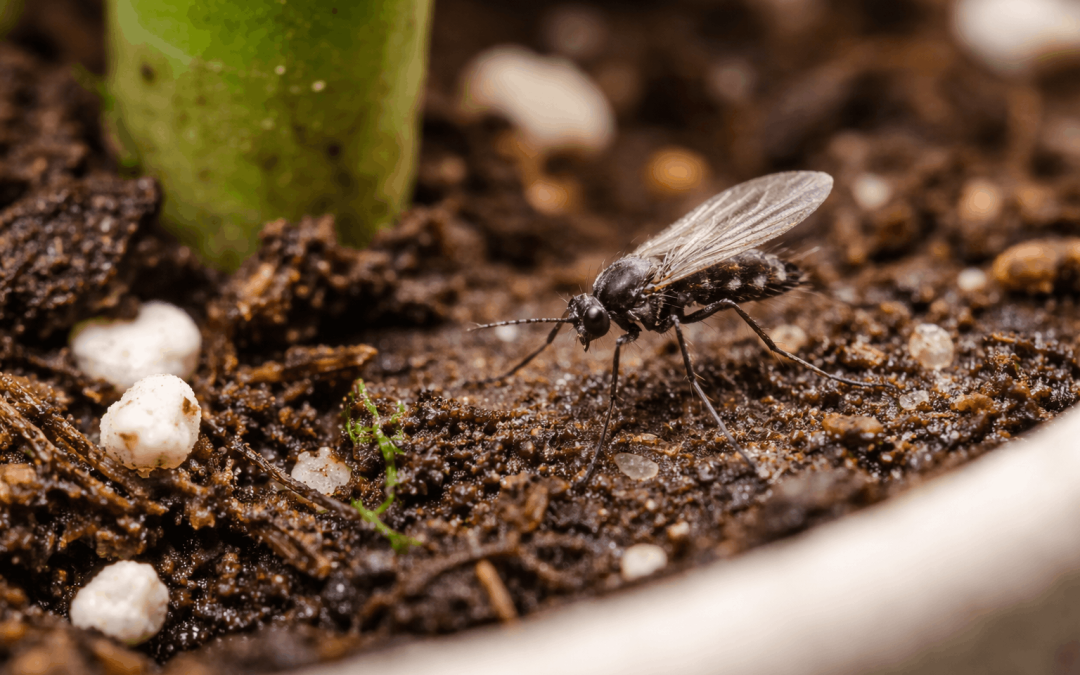
It always starts the same way…
You’re sitting near a window, maybe with a cup of coffee, and you notice a tiny fly drifting lazily through the air. Then another. Then a few more. They’re not fast like fruit flies, not fuzzy like drain flies, just small, annoying, and suddenly everywhere.
At first, it feels random. You check the screens, clean out window tracks, spray window sills, still they persist.
That’s when the question hits:
What are these things, and why are they in my house?
In most cases, you’re just looking in the wrong direction. The answer is right behind you in the dining room sitting on a shelf next to the picture of your great granddaughter and your signed copy of “A Shore Thing” by Nichole “Snooky” Polizzi. It’s your spider plant, and those tiny flies that are emerging from it are called fungus gnats, and while they’re not dangerous, they are very good at telling you something about what’s going on in your soil.
Key Takeaways
- Fungus gnats are small flies that develop in moist soil, not drains or fruit
- Adults are mostly a nuisance — larvae are the real issue
- Overwatering is the #1 cause of infestations
- Windows are where you notice them, not where they come from
- Effective control focuses on drying soil and targeting larvae, not just killing adults
What Are Fungus Gnats?
Fungus gnats are small, delicate flies commonly associated with houseplants. They belong to families like Sciaridae and thrive in moist, organic-rich soil.
They’re often mistaken for:
- Fruit flies (which are attracted to fermenting food)
- Drain flies (which breed in biofilm inside drains)
- Mosquitoes (typically drawn indoors by light)
But fungus gnats are different — they’re tied almost entirely to soil conditions.
Why You Suddenly Notice Them at Windows
This is one of the most common points of confusion.
Fungus gnats don’t originate at windows — they just end up there.
Adults are weak fliers and are strongly attracted to light. Once they emerge from soil, they drift toward windows and accumulate there, making it seem like that’s the source.
In reality, the source is almost always a nearby plant.
Fungus gnats are small, mosquito-like flies that develop in moist soil and are commonly seen near houseplants and windows.
How to Identify Fungus Gnats
Size: About 1/8 inch or smaller
Color: Dark gray to black
Body: Slender, mosquito-like
Legs: Long and delicate
Flight: Weak, drifting, almost hovering
Location: Near soil, plants, and windows
Quick Tip:
If they appear when you disturb the soil or water a plant, you’re almost certainly dealing with fungus gnats.
Finding the Source
Fungus gnats are extremely source-dependent. If you find the source, you solve the problem.
Check:
- Houseplants (top 1–2 inches of soil)
- Recently purchased plants
- Overwatered pots
- Poorly draining containers
- Decorative plant groupings (where moisture stays high)
A simple test:
Lightly tap or disturb the soil. If small flies emerge, you’ve found your breeding site.
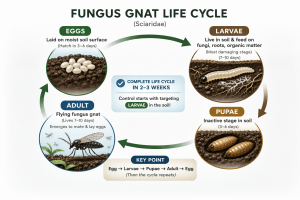
Fungus gnats develop in moist soil, progressing from eggs to larvae, pupae, and adults in as little as 2–3 weeks
Understanding Their Life Cycle
This is where control really starts to make sense.
- Eggs – Laid in moist soil
- Larvae – Live in soil, feeding on fungi, organic matter, and sometimes plant roots
- Pupae – Develop in soil
- Adults – Emerge, mate, and repeat the cycle
The full cycle can take as little as 2–3 weeks, which is why populations seem to explode quickly.
Important:
Adults are what you see. Larvae are what sustain the infestation.
Why They Matter
Fungus gnats are mostly a nuisance, but they can:
- Damage roots in seedlings and sensitive plants
- Spread fungal pathogens
- Indicate chronic overwatering
- Create persistent indoor annoyance
They’re less about danger — more about conditions.
Treatment Strategies (IPM Approach)
Effective control requires attacking the problem from multiple angles.
-
Drying the Soil (Most Important Step)
Fungus gnats need moisture to reproduce.
- Allow soil to dry between waterings
- Avoid constantly damp conditions
- Improve drainage if needed
This alone can dramatically reduce populations.
-
Repotting (When Conditions Are Severe)
If soil is heavily infested:
- Remove plant from pot
- Discard old soil
- Clean roots gently
- Repot with fresh, well-draining mix
This is one of the fastest resets you can do.
-
Sand or Grit Barrier
A physical barrier works surprisingly well.
- Apply a thin layer of sand or fine gravel on top of soil
- Prevents adults from laying eggs
- Reduces emergence of new adults
Think of it as “closing the runway.”
-
Yellow Sticky Traps
These are your monitoring and suppression tool.
- Place near soil surface
- Capture adult gnats
- Help gauge population levels
They won’t solve the problem alone — but they’re essential for tracking progress.
-
Biological & Targeted Treatments
For persistent issues, you can target larvae directly.
Common options include:
- Beneficial nematodes
- Bacterial larvicides (like Bacillus thuringiensis israelensis)
- Certain labeled soil treatments
These work by interrupting the larval stage — where control is most effective.
What Doesn’t Work Well
- Spraying adults only
- Ignoring soil moisture
- Treating windows instead of plants
- Overcorrecting with constant chemical use
If larvae remain in the soil, the cycle continues.
When to Call a Professional
Most fungus gnat issues can be handled at home.
But professional help may be useful when:
- Infestations are widespread across many plants
- Commercial or office environments are affected
- Moisture issues are structural or ongoing
- You want a structured IPM program
At Good Earth, we focus on identifying the moisture source and breaking the life cycle — not just chasing adults.
Final Thoughts
Fungus gnats feel like they show up out of nowhere.
But they don’t.
They’re a signal — a small, persistent reminder that something in your soil is staying just a little too wet for a little too long.
Once you shift that condition, everything else falls into place.