
If you’ve lived in the Willamette Valley for any length of time, there’s a good chance you’ve had a pest control salesperson knock on your door. Maybe they told you they were already treating several of your neighbors’ homes. Maybe they offered you a substantial discount if you signed up that afternoon. Or maybe they just happened to be in the neighborhood and wanted to tell you about all the bugs you didn’t realize you had.
We get questions about these companies fairly regularly. Who are they? Why are they so aggressive about signing people up? Are they legitimate pest control companies? And how are they different from a locally owned company like Good Earth Pest Company?
These are fair questions, and I think they’re worth answering. Door-to-door sales have become a prominent part of the pest control industry, and the business model behind them can be quite different from the one we operate.
Now, I want to be clear about something before we get too far into this. There are excellent technicians working for large pest control companies, and there are poorly run small businesses. Company size alone doesn’t tell you whether somebody knows how to control ants. We’re not interested in throwing stones at our competitors, but I do think customers should understand what they’re being sold, who’s selling it, and what happens after the salesperson leaves.
Key Takeaways
- Door-to-door pest control is primarily a customer-acquisition strategy. It doesn’t necessarily tell you anything about the quality of the pest control being provided.
- Some companies use dedicated sales teams whose primary responsibility is signing up customers rather than performing pest control.
- Introductory discounts can be attractive, but it’s important to understand the total cost of service and any contractual obligations.
- Good Earth Pest Company doesn’t require term agreements or charge cancellation fees.
- Locally owned businesses can offer advantages in flexibility, communication, and personal accountability.
- Regardless of company size, good pest control depends on knowledgeable technicians, proper identification, thoughtful inspections, and appropriate treatments.
Why Are There So Many Door-to-Door Pest Control Salespeople?
Pest control is an interesting business because many of the services we provide are recurring. A customer might initially call about ants, but they may also want ongoing protection against spiders, rodents, and other pests throughout the year. Once a company establishes a good relationship with that customer, they may continue providing service for years.
That recurring revenue makes pest control an attractive industry for companies looking to grow quickly. Rather than waiting for customers to search for a pest professional when they have a problem, some businesses send sales teams directly into neighborhoods to recruit customers. Some of these companies operate across multiple states, with sales teams moving into different markets during the warmer months when homeowners are spending more time outside and pest activity is increasing.
It’s a pretty straightforward strategy. A salesperson knocks on enough doors, signs up enough households, and the company gains a group of recurring service accounts. Those accounts can then be assigned to technicians who perform the actual pest control work.
There’s nothing inherently wrong with that arrangement. Plenty of industries separate sales from service, and pest control is no exception. The important distinction is that the person selling you the program may not be the person who inspects your home, performs the treatment, or manages your pest problems over the next several years.
That’s where customers should start asking questions.

Big promises, a convincing pitch—but what’s actually in the bottle?
The Salesperson and the Pest Professional Aren’t Necessarily the Same Person
One of the biggest differences between a sales-driven pest control model and a more traditional service-oriented business is the role of the person who first visits your property.
A door-to-door salesperson may be very knowledgeable about the company’s service plans, pricing, and promotions. Some have pest control experience or licensing, while others are primarily trained in sales. Their job is to explain the program and convince you to enroll.
A pest control technician has a different responsibility. We need to identify pests, understand their biology, inspect for conditions contributing to the problem, select appropriate treatments, follow pesticide labels, and explain what the customer can reasonably expect. Those are different skill sets, and being good at one doesn’t automatically make someone good at the other.
At Good Earth, we put a great deal of emphasis on technical knowledge. We want our technicians to understand why they’re performing a particular service rather than simply following a checklist of places to spray. If a customer has carpenter ants, for example, the approach may be quite different from what we’d recommend for odorous house ants. Both are ants, but their nesting habits, behavior, and appropriate management strategies can be very different.
That’s the kind of distinction that matters when you’re developing a pest management program. It may not be the most exciting conversation to have on somebody’s front porch, but it can make a significant difference in the results.
What’s With the Discounts and Same-Day Offers?
You’ve probably heard some variation of this pitch: “We’re already servicing several homes in your neighborhood, so we can offer you a special rate if you sign up today.”
There may be a legitimate logistical advantage to servicing several properties in the same neighborhood. Less driving between accounts can reduce operating costs, and businesses sometimes pass some of those savings along to customers. But there’s also a sales strategy at work. A limited-time offer encourages you to make a decision while the salesperson is standing in front of you, rather than taking a few days to compare options.
That doesn’t automatically make the offer dishonest or the service a bad value. It does mean you should look beyond the introductory price. Some pest control companies offer substantial discounts on the initial treatment in exchange for a commitment to recurring service. Depending on the agreement, canceling early may result in additional charges or repayment of that initial discount.
At Good Earth, we don’t require term agreements or charge cancellation fees. We offer recurring pest control because we believe ongoing prevention is valuable, not because we want customers locked into a contract. If you’re happy with our service, we hope you’ll stick around. If your circumstances change or you decide you no longer need us, that’s your decision.
Personally, I think pest control is a strange thing to buy under pressure. The ants have probably been living in your yard for years. Unless you’re dealing with an urgent situation, you can probably take an evening to read the contract.
Is a Bigger Pest Control Company Better?
Not necessarily. But it isn’t automatically worse, either.
Large pest control companies can have some genuine advantages. They may have extensive training resources, specialized departments, sophisticated scheduling systems, and the ability to serve customers across multiple regions. For certain types of commercial accounts, that geographic coverage can be particularly useful.
The trade-off is that larger organizations often need more standardized procedures to operate consistently across a large customer base. Standardization can be helpful, but pest problems don’t always cooperate with standardized service packages.
A house with a recurring carpenter ant problem, heavy rodent pressure, and extensive vegetation against the foundation may need a different approach from a newer home experiencing occasional spiders around the exterior lighting. A standardized program can provide a useful starting point, but somebody still needs to recognize when the situation calls for something different.
Small local businesses have their own challenges, of course. We don’t have unlimited resources or a technician stationed in every city in America. What we can offer is a closer connection between the people managing the company, the technicians performing the work, and the customers receiving the service.
At Good Earth, we’re not trying to build the same program for every house. We have established service options, but our technicians can make recommendations based on what they actually find. If the situation changes, we can adapt our approach rather than pretending every pest problem fits neatly into the same box.
What Does Locally Owned Actually Mean for the Customer?
“Shop local” is one of those phrases that gets used so often it can start to lose its meaning. I don’t think being locally owned should automatically earn a company your business. We still have to do good work, communicate effectively, and charge a fair price.
But there are some practical differences worth considering.
When you work with a smaller local company, the people making decisions about your service are generally closer to the people actually performing it. Customer feedback doesn’t necessarily have to travel through multiple layers of management before something changes. If a technician identifies a recurring problem or thinks an account needs a different approach, there may be more room to make that adjustment.
There’s also a level of personal accountability that comes with operating in the same communities where your customers live. We’re not an anonymous brand to the people we serve. Our reputation is built through years of service, word of mouth, and the experiences customers have with our technicians.
That’s not to suggest large companies don’t care about their reputations. Of course they do. But for a small local business, those relationships are particularly important. We don’t have the luxury of treating every customer like a number on a spreadsheet and assuming a new sales campaign will replace them.
We want customers to stay because they’re happy with the service, not simply because they signed an agreement they didn’t fully understand.
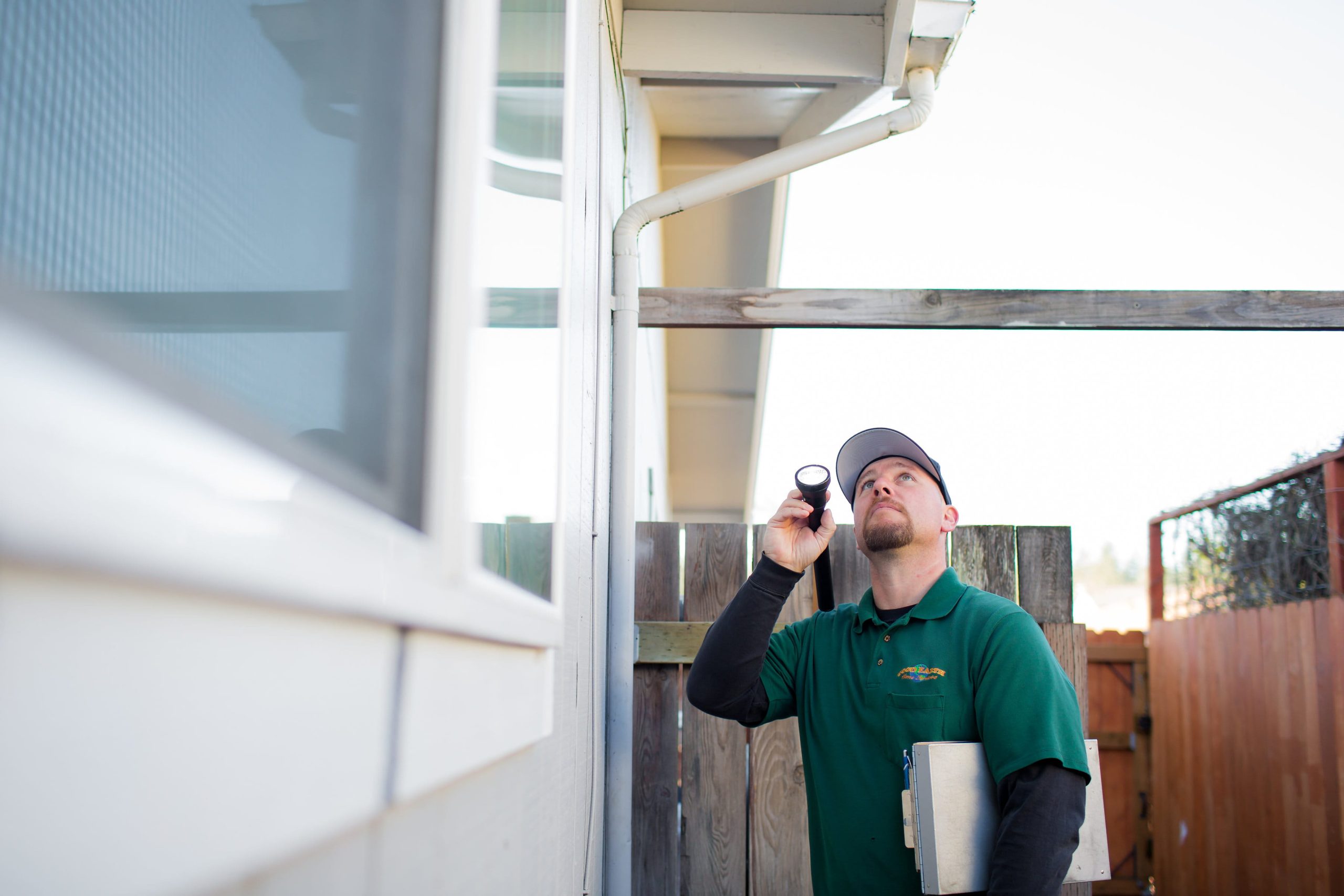
Good pest control starts with a closer look—checking the places where pests can enter, hide, and nest.
The Value of Preventative Pest Control
One thing that both large and small pest control companies generally agree on is the value of preventative service. There’s a good reason for that. Pest populations are constantly changing, and many of the problems we encounter are much easier to manage before they’ve had an opportunity to become established.
Here in western Oregon, we have pests like rodents and odorous house ants that can remain active throughout much of the year, along with seasonal visitors like carpenter ants and yellowjackets. A well-designed preventative program accounts for those patterns, allowing us to address predictable pest activity while keeping an eye out for developing problems.
Our recurring services at Good Earth are designed around that approach. We inspect, monitor, make targeted treatments where appropriate, and provide recommendations that help make the property less attractive to pests. Sometimes that means addressing an active problem, while other visits are focused primarily on prevention. The objective is to maintain control over time rather than waiting for something to become a major issue.
We also recognize that different properties have different needs. Some customers want comprehensive ongoing protection, while others may only need help with a particular pest. We offer both recurring programs and one-time services, and we’re happy to explain the advantages of each.
Ultimately, a preventative program should demonstrate its value through the service being provided. We want customers to continue working with Good Earth because they appreciate the results, the expertise, and the relationship they’ve developed with their technician. Not because a contract says they have to.
Are Door-to-Door Pest Control Companies Legitimate?
Many are. Door-to-door sales are a legitimate way to market pest control services, and a company’s choice to use that method doesn’t tell you whether its technicians are competent or its treatments are appropriate.
There are, however, a few things I’d encourage any homeowner to consider before signing up with a company that knocks on the door.
Questions worth asking include:
- What pests are actually covered under the service agreement?
- Is the quoted price introductory, or is it the regular service price?
- How frequently will treatments be performed, and what will the total annual cost be?
- Is there a minimum contract term, automatic renewal, or cancellation fee?
- What happens if pest activity continues between scheduled visits?
- Who will perform the service, and what training or licensing do they have?
- Will the technician inspect the property and adjust the treatment based on what they find?
- Can I review the agreement before making a decision?
Here in Oregon, pesticide application businesses and applicators are subject to state licensing requirements. Customers can check credentials through the Oregon Department of Agriculture rather than relying solely on what someone says at the door.
And if a salesperson tells you that all your neighbors have signed up, or that your house urgently needs treatment because of a pest problem they noticed from the sidewalk, it’s perfectly reasonable to ask for specifics. What pest did they identify? What evidence did they observe? Why does that particular problem require the proposed treatment?
Good pest control recommendations should stand up to reasonable questions.
The Difference Between Selling Pest Control and Providing Pest Control
Sales are necessary for any business. We advertise, answer inquiries, provide estimates, and explain why someone might benefit from our services. There’s nothing wrong with wanting to grow a company, and there’s nothing inherently wrong with employing people whose job is to sell.
But pest control is ultimately a technical service, and the quality of that service depends on what happens after the sale.
Did the technician identify the pest correctly? Did they inspect the property? Did they select a treatment appropriate for the problem? Were the products used according to their labels? Did they communicate what they found and explain what the customer should expect? Are they monitoring the results and making adjustments when necessary?
Those are the things that determine whether a pest management program is actually doing its job.
A great sales pitch might get someone to sign up, but it won’t eliminate a carpenter ant colony, exclude mice from a crawlspace, or solve a persistent cockroach infestation. That takes knowledge, experience, and a willingness to investigate what’s really happening.
Final Thoughts
I don’t have anything against door-to-door salespeople as individuals. They’re doing a job, and many of them are probably working extremely hard at it. I also don’t think every large pest control company provides inferior service. There are talented, dedicated pest professionals working throughout this industry, regardless of the logo on their shirts.
What I do believe is that customers deserve to understand the business model behind the service they’re purchasing. A polished sales presentation, an introductory discount, or a claim that everyone in the neighborhood is signing up shouldn’t substitute for a thoughtful inspection and a clear explanation of what you’re paying for.
At Good Earth Pest Company, we’ve chosen to build our business around knowledgeable technicians, practical pest management, honest communication, and relationships with the communities we serve. We’re a locally owned company, and we’re proud of that, but we also recognize that being local isn’t enough by itself. We have to earn our customers’ trust every time we show up.
We also believe that trust should be earned continuously. That’s why we don’t require term agreements or charge cancellation fees. We want you to choose Good Earth because we’re doing a good job, not because leaving would cost you money.
So the next time someone knocks on your door offering pest control, hear them out if you’re interested. Ask questions, read the agreement, and compare your options. There may be a perfectly good service behind that sales pitch.
Just remember that the person who sells you pest control and the person who actually solves your pest problem aren’t always the same person.
And when it comes to getting rid of the bugs, I know which one I’d rather have a conversation with.