
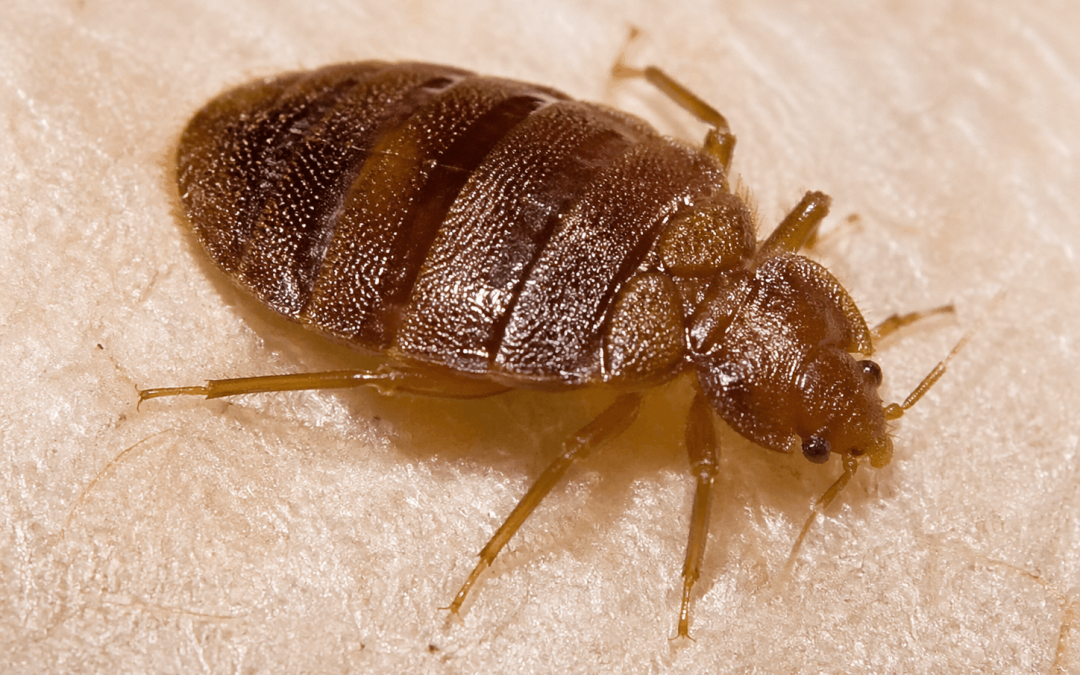
If you’ve just found out you might have bed bugs, let me start by saying this: take a breath. It happens more often than people think, and it has nothing to do with cleanliness. These things are expert hitchhikers. Hotels, travel, used furniture—even just a quick visit somewhere—they don’t need much of an invitation.
Now the next question is usually: “What happens next?”
What does a bed bug inspection actually look like? What are we doing? What do you need to do? And how long does this whole thing take?
Let’s walk through it.
Key Takeaways
- Bed bug service starts with a thorough inspection and positive ID
- Panicking and moving items can spread the infestation
- Cooperation from the client is critical to success
- Treatments are targeted and detailed, not a blanket spray
- Follow-up is usually required; this is a process, not a one-and-done
Step 1: The Inspection (Figuring Out What We’re Dealing With)
As a company that believes in doing things the right way, and holding to the core principles of IPM (Integrated Pest Management), the most important step is the inspection.
Your technician will arrive ready to do some detective work, and that always starts with an interview. We need to hear your bed bug story. What are you seeing? When did it start? Who is getting bit? Where are they getting bit?
While asking these questions, we’ll usually start at the bed, or wherever you feel like there is the most activity. What we’re initially looking for is a positive ID. That could be:
- Live adults or immature bugs (instars)
- Eggs
- Cast skins
- Fecal spotting
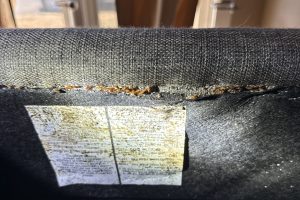
A heavy bed bug infestation concentrated along a seam, showing live bugs, shed skins, and dark fecal staining.
Because here’s the deal—if you don’t know what you’re treating for, nothing else matters. Can you imagine paying for a bed bug treatment and it turns out to be fleas? Or a skin reaction? It happens.
Once we confirm bed bugs, the focus shifts to understanding the extent and origin of the infestation. That’s where the questions get a little more personal:
- Recent travel?
- Houseguests?
- Used furniture?
- Favorite chair you spend a lot of time in?
We’re building a timeline and movement pattern.
Bed bugs are what’s called positively thigmotactic, meaning they like tight spaces where they’re pressed on both sides. Translation: they hide well. So after the initial find, we expand the inspection outward—working in wider and wider circles, repeating the process in other areas of the home.
The goal isn’t just to find bugs. It’s to build the story of how they got there and how they spread.
And just to set expectations, these inspections are thorough. Drawers, closets, under mattresses, stored items…we’re going through it. So maybe don’t leave anything out that you don’t want judged. Kidding. Mostly.
Step 2: Preparation (This Is Where You Come In)
This is the part that makes or breaks a bed bug service.
Preparation will vary depending on the situation, but generally it includes:
- Reducing clutter so all areas can be accessed
- Laundering clothing and bedding
- Bagging and isolating items
- Disposing of heavily infested items if necessary
The tricky part is doing all of this without spreading the problem.
If you’re moving clothes or bedding, they should go straight into the wash—not into a basket sitting in another room. A full hot wash and dry cycle will eliminate bugs and eggs.
Anything you need daily should be stored in a clean, separate “safe zone” so you’re not rechecking everything constantly.
And if something needs to be thrown away—throw it away properly. Don’t donate it. Don’t set it out for someone else to grab. Label it if it’s going to the curb.
Let’s not pass this problem down the line.
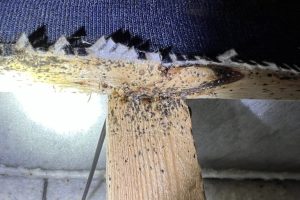
Bed bug harborages on a bed frame, with heavy fecal spotting and evidence of activity beneath the fabric edge.
Step 3: The Treatment (Where the Work Happens)
This isn’t a “spray the room and call it good” situation.
Bed bug treatments are detailed, methodical, and targeted.
We typically start by continuing inspection while working through the room. Items may be bagged and isolated as we go—especially things like bedding, clothing, and contents of furniture.
In heavier infestations, we may begin with vacuuming to quickly knock down the population. It’s not the whole solution, but it helps reset the playing field.
From there:
- Steam is used on mattresses and upholstered furniture to eliminate live bugs and eggs
- Mattress encasements are installed to trap anything remaining and simplify future inspections
- Dusts are applied into cracks, crevices, and voids
- Liquid treatments are applied to furniture frames, baseboards, and key travel areas
These products don’t just kill on contact; they stay active, waiting for bed bugs to come out and do what they always do…which is try to feed.
Step 4: What Happens After Treatment
This is where expectations matter.
You may still see bed bugs after treatment. That’s normal.
They don’t all come out at once. You’ve got:
- Different life stages
- Eggs that hatch after treatment
- Bugs hidden deep in harborages
Eventually, they all have to come out. Bed bugs rely entirely on blood for food and water. When they do, they contact treated areas, and that’s when the process finishes the job.
Trust the process.
Step 5: Follow-Up (Finishing the Job)
In most cases, bed bug control is a multi-visit process.
About 2–3 weeks after the initial treatment, your technician will return. This visit is more focused:
- We talk with you about what you’re seeing
- We reinspect key areas
- We address any remaining activity
- We apply a different product with a different mode of action
This rotation helps prevent resistance and ensures anything that survived the first round doesn’t survive the second.
This is where we dial everything in and make sure the problem is fully resolved.
A Few Things to Know Going In
- There is no warranty on bed bug work. Not because we don’t stand behind it, but because reinfestation and human behavior are outside anyone’s control
- DIY treatments often make things worse by spreading bugs or pushing them deeper into hiding
- Communication is key—the more we know, the better we can help
Final Thoughts
Bed bugs are frustrating. They’re stressful. They mess with your sleep and your peace of mind.
But they are also very controllable when handled the right way.
At Good Earth, we don’t just treat the problem, we build a plan, execute it carefully, and work with you through the process to get results.
If you’re dealing with bed bugs and aren’t sure what to expect, give us a call. We’ll walk you through it step by step and make sure you’re not going through it alone.
We’ve got this.