
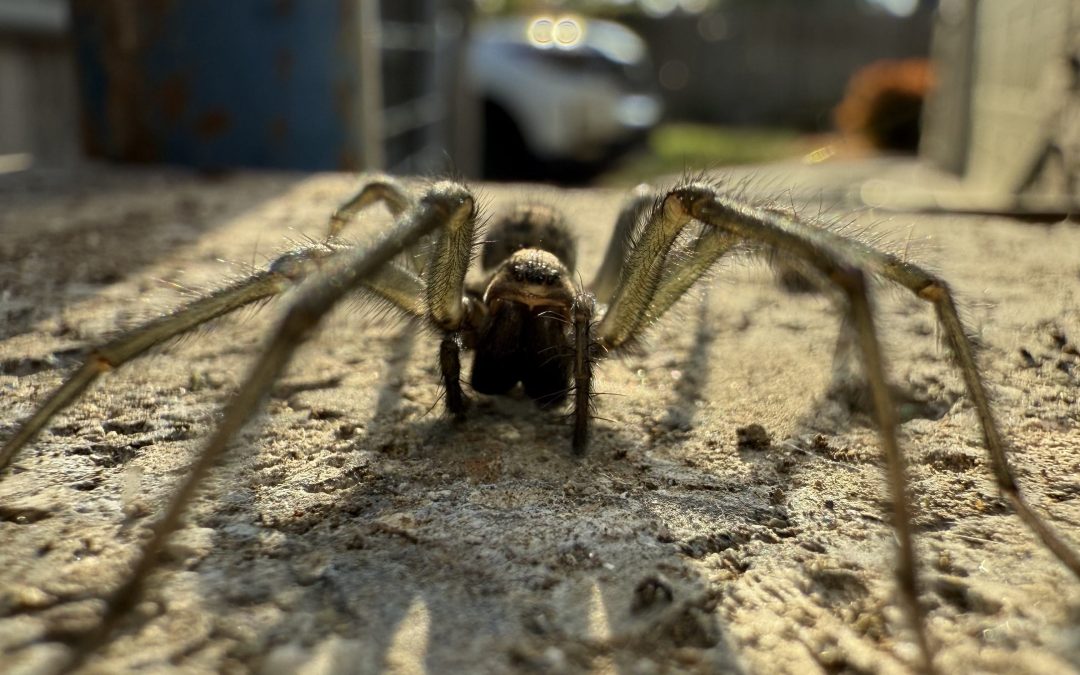
If you’ve ever found a large brown spider running across your garage floor, there’s a good chance you’ve wondered whether it was a hobo spider. And if you’ve spent any time looking up hobo spiders online, you’ve probably encountered warnings about dangerous bites, flesh-eating venom, and comparisons to the infamous brown recluse.
The problem is that much of this information is outdated or simply incorrect.
Hobo spiders are common in parts of Oregon, but their reputation for being dangerous is largely undeserved. Brown recluse spiders, on the other hand, can cause medically significant bites, but they aren’t established in Oregon.
So how did these two spiders become so closely associated, and how can you tell them apart?
Key Takeaways
- Hobo spiders are not considered medically significant. There’s no convincing evidence that their venom causes necrotic wounds.
- Brown recluse spiders can cause tissue damage, although serious reactions are relatively uncommon.
- Brown recluse spiders are not established in Oregon, while hobo spiders are found throughout portions of the Pacific Northwest.
- Hobo spiders and brown recluses look different, but identifying either species from a casual glance can be difficult.
- Hobo spiders aren’t aggressive toward people, despite their reputation.
- You cannot reliably identify a spider bite from the appearance of a skin lesion.
Are Hobo Spiders Dangerous?
Hobo spiders (Eratigena agrestis) are relatively large, brown spiders commonly found around foundations, landscaping, garages, and other sheltered locations. They’re fast runners, which can make them seem particularly intimidating when one suddenly appears indoors.
For years, hobo spiders were blamed for painful bites and necrotic wounds, injuries involving the death of skin tissue. They were even described as one of the most dangerous spiders in the Pacific Northwest.
Today, however, hobo spiders are not considered medically significant. Like most spiders, they can bite if trapped against the skin or handled, but research hasn’t established that their venom causes the serious wounds historically attributed to them.
How Did Hobo Spiders Get Such a Bad Reputation?
This is where the story gets interesting.
During the 1980s, researchers were investigating unexplained necrotic skin lesions in the Pacific Northwest. Some of these wounds had been attributed to brown recluse spiders, despite the fact that brown recluses weren’t established in the region.
One researcher, Darwin Vest, began investigating whether hobo spiders might be responsible. In 1987, Vest and his colleagues published research reporting that hobo spider bites caused skin lesions in laboratory rabbits. This helped establish the theory that hobo spider venom could cause tissue necrosis in humans.
The theory gained traction, eventually appearing in medical publications and public health reports. Before long, hobo spiders had developed a reputation similar to brown recluses.
There was just one problem: subsequent research didn’t support the original conclusions.
Later studies failed to reproduce the reported necrotic effects, and there was little convincing evidence connecting verified hobo spider bites to serious skin injuries. Researchers also pointed out that hobo spiders are native to Europe, where they had never been associated with necrotic bites.
Today, the evidence doesn’t support classifying hobo spiders as medically dangerous. But once a spider develops a reputation for causing flesh-eating wounds, apparently it’s difficult to convince people otherwise.
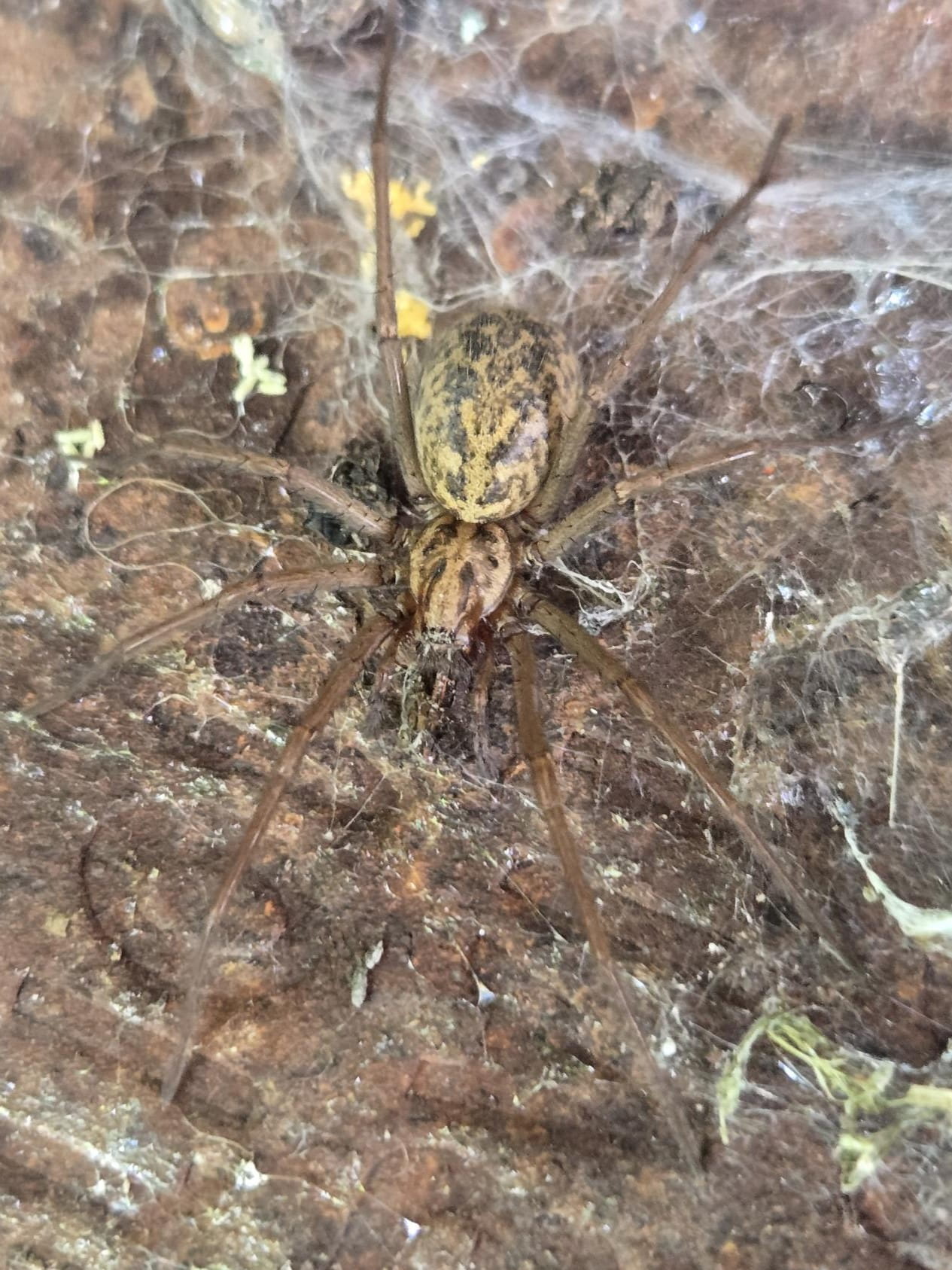
A closer look at a funnel weaver, surrounded by silk woven across the bark.
Are Hobo Spiders Aggressive?
No. Despite sometimes being called the “aggressive house spider,” hobo spiders don’t actively pursue people or seek opportunities to bite.
The name itself is misleading. The species name agrestis refers to fields or rural environments, not aggression.
Hobo spiders are fast-moving and generally attempt to escape when disturbed. Sometimes that escape behavior can look like an attack. Spiders often seek dark, sheltered areas, and if you’re casting a shadow across the floor, a spider may run toward it looking for cover. From your perspective, it can appear to be charging directly at you.
Of course, not every spider running toward someone is following a shadow. But seeking shelter is a much more plausible explanation than a spider deciding to attack a human.
What’s the Difference Between Hobo Spiders and Brown Recluse Spiders?
Although both are brown spiders, hobo spiders and brown recluses belong to entirely different spider families.
Hobo spiders are funnel weavers in the family Agelenidae. Brown recluse spiders (Loxosceles reclusa) belong to the family Sicariidae.
They also differ considerably in appearance, geographic distribution, and medical significance.
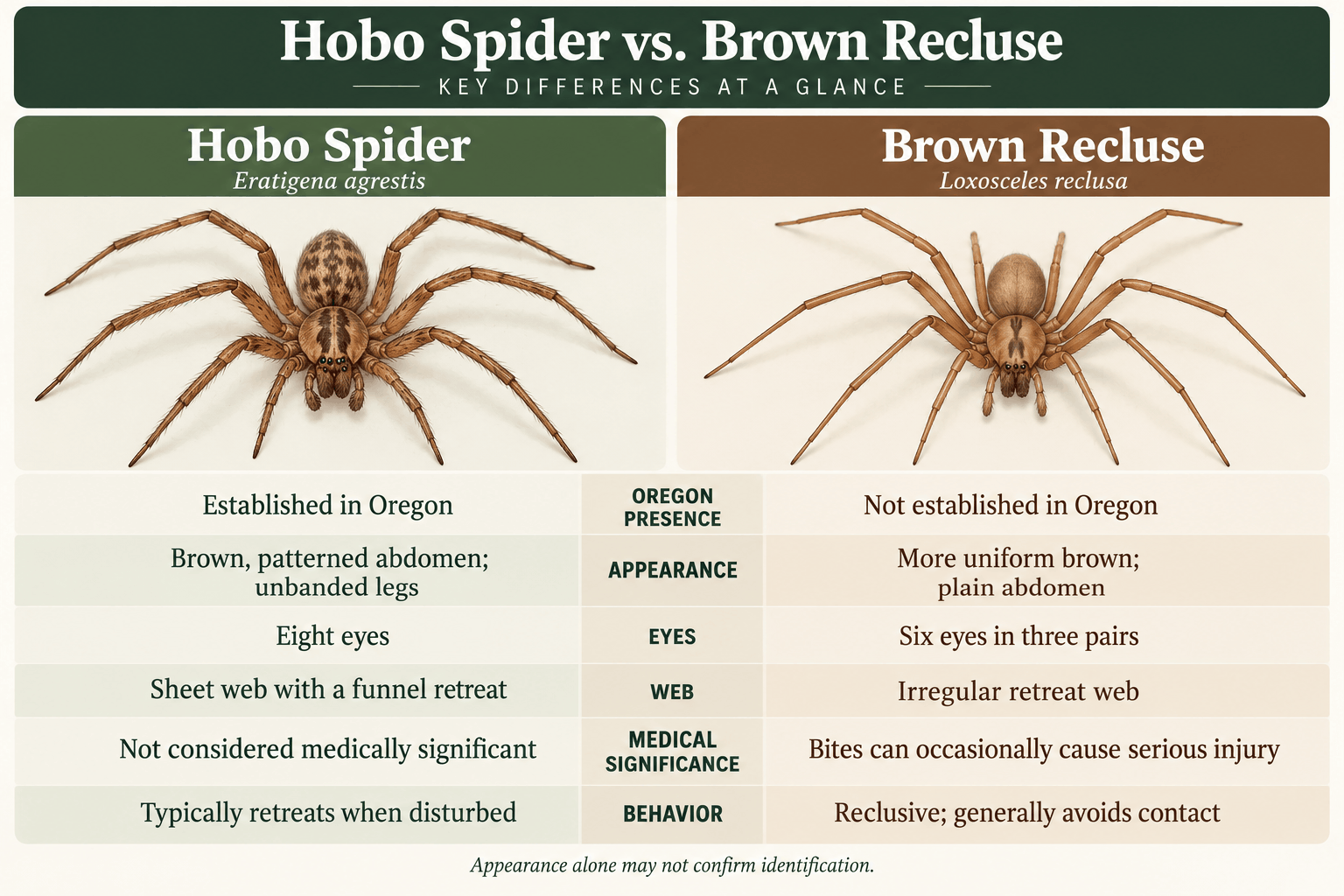
Similar colors can cause confusion. This comparison highlights differences between hobo spiders and brown recluses.
How Can You Tell Them Apart?
Hobo spiders typically have patterned bodies and relatively long legs. They’re funnel-weaving spiders, often found in sheltered locations around buildings and landscaping.
Brown recluse spiders are generally more uniformly brown and may have a dark, violin-shaped marking on the front portion of their bodies. However, the violin marking isn’t a reliable identification feature by itself because other spiders can have similar markings.
One of the more distinctive differences is the eyes. Hobo spiders have eight, while brown recluses have six arranged in three pairs.
Unfortunately, counting spider eyes isn’t especially practical without magnification.
For Oregon homeowners, geographic distribution is often the most useful clue. If you find a brown spider in Oregon, it’s extraordinarily unlikely to be a brown recluse.
An individual recluse could theoretically arrive in furniture or belongings transported from another state, but there are no known established brown recluse populations in Oregon.
Can You Identify a Spider Bite by Looking at It?
No, and this is probably the most important thing to understand about suspected spider bites.
Redness, swelling, itching, pain, and even open sores can result from numerous causes, including bacterial infections, allergic reactions, other arthropods, and medical conditions unrelated to pests.
Unfortunately, unexplained skin lesions are frequently blamed on spiders without anyone actually observing a bite.
This is particularly problematic when someone is told they have a brown recluse bite in a state where brown recluse spiders aren’t established.
Spiders don’t feed on human blood, and they have no reason to seek people out. Most spider bites occur when a spider is accidentally trapped against the skin or otherwise threatened.
If you’re experiencing unexplained or worsening skin lesions, medical evaluation is important. As pest management professionals, we can help identify spiders and other arthropods, but we can’t diagnose the cause of a skin lesion from its appearance.
Do Hobo Spiders Need to Be Treated?
Not necessarily.
Hobo spiders are predators that feed on insects and other small arthropods. Outdoors, they’re generally beneficial and don’t require control simply because they’re present.
If spiders are regularly entering your home, exclusion and habitat modification can help. Sealing gaps around doors and windows, reducing clutter, removing unnecessary stored materials near foundations, and addressing insect activity can all make a difference.
Professional pest management may be appropriate when spider activity becomes persistent or troublesome, but identifying the species and understanding the conditions contributing to the problem should come before deciding on treatment.
Final Thoughts
Hobo spiders and brown recluse spiders have been associated with one another for decades, largely because of early research suggesting that hobo spiders might cause the same kinds of wounds as brown recluses.
That theory hasn’t held up.
Hobo spiders are established in Oregon but aren’t considered medically significant. Brown recluse spiders can cause medically important bites, but they aren’t established here.
And that large brown spider racing across your garage floor? It’s probably far more interested in finding somewhere to hide than it is in biting you.
If you’re finding spiders around your home and aren’t sure what you’re dealing with, Good Earth Pest Company can help with identification, inspection, and practical recommendations for managing unwanted spider activity.
Sometimes the best pest control advice is simply knowing when something doesn’t need to be controlled.

About the Author
Adam Hiddleson is an Associated Certified Entomologist (ACE) and serves as Technical Director for Good Earth Pest Company.
Sources and Further Reading
At Good Earth Pest Company, we believe accurate identification and reliable scientific information are essential to good pest management. For readers interested in learning more about hobo spiders, brown recluse spiders, and the research behind their medical reputations, we recommend these resources:
- Oregon State University Extension – Regional information about spider identification and species found in Oregon.
- Burke Museum – Spider Myths – Information about common spider misconceptions, including hobo spider aggression and medically significant bites.
- University of California Integrated Pest Management – Hobo Spider – Reviews hobo spider identification, biology, and the scientific evidence surrounding their supposed toxicity.
- CDC – Historical Report on Necrotic Arachnidism – A 1996 report documenting historical concerns about hobo spider bites. Included for historical context rather than as a reflection of current scientific understanding.
- University of California Integrated Pest Management – Spiders – Information about spider identification, medically significant species, and management.