Yes. We use chemicals.
I know, I know. Not exactly the answer you’d expect from a pest control company trying to reassure you about what we’re putting around your home. But it’s the truth, and I think it’s a better place to start than dancing around the question with words like natural, green, or eco-friendly.
The word “chemical” has developed something of a reputation. For a lot of people, it conjures up images of industrial waste, smoking barrels, and the sort of stuff that turns ordinary turtles into crime-fighting ninjas. In reality, chemicals are simply substances with particular compositions and properties. Water is a chemical. The caffeine in your morning coffee is a chemical. The essential oils in that all-natural bug spray you bought at the farmers market? Chemicals.
Of course, that doesn’t mean all chemicals are harmless. Far from it. Some are extremely hazardous, and pesticides are specifically designed to affect living organisms. It’s perfectly reasonable to want to know what we’re using around your family, pets, and property.
At Good Earth Pest Company, we believe those questions deserve straightforward answers. So let’s talk about what we use, why we use it, and what the actual risks look like.
Key Takeaways
- Yes, Good Earth uses chemical pesticides, but they’re only one part of our pest management approach.
- We use several categories of products, including repellents, non-repellents, insect baits, rodenticides, insect growth regulators, and dusts.
- Pesticides have varying degrees of toxicity. The risk they present depends on both their toxicity and the amount and type of exposure.
- Natural and organic pesticides are still chemicals and aren’t automatically less hazardous than conventional products.
- We use Integrated Pest Management (IPM) to reduce unnecessary pesticide applications and address the conditions contributing to pest problems.
- Product selection, application location, dosage, and preventing unnecessary exposure are important parts of every treatment.
What Do We Mean When We Say a Pesticide Is Toxic?
Let’s get this one out of the way early, because it’s probably the most important distinction in the entire conversation.
Toxicity and risk are not the same thing.
Toxicity describes a substance’s ability to cause harm. Risk describes the likelihood of that harm occurring under a particular set of circumstances. To understand risk, we need to consider not just how toxic something is, but also how much exposure occurs, how that exposure happens, and how often it happens.
The Environmental Protection Agency summarizes this relationship as:
Risk = Toxicity × Exposure
That’s a simplified equation, but it illustrates an important principle. A highly toxic substance that someone never encounters may present very little risk to that person. Meanwhile, repeated or excessive exposure to a substance with relatively low toxicity can still cause problems.
Consider household bleach. It’s useful for cleaning and disinfecting, but nobody would recommend drinking it or spraying it in your eyes. We understand that its usefulness depends on how it’s handled. Pesticides deserve the same kind of consideration, although their hazards and required precautions vary considerably from product to product.
This is why I hesitate when somebody asks whether a particular pesticide is “safe.” Safe under what circumstances? For whom? At what concentration? Applied where? How frequently?
Those details matter, and they’re exactly the sort of things a professional pest control technician should be thinking about.
What Kinds of Pesticides Does Good Earth Use?
We have quite a few different tools available, and they don’t all work the same way. Some are designed to repel or kill insects that contact a treated surface, while others work through feeding, delayed action, or interference with insect development.
The products we choose depend on the pest, the environment, and what we’re trying to accomplish. Here’s a look at the major categories.
Repellent Insecticides
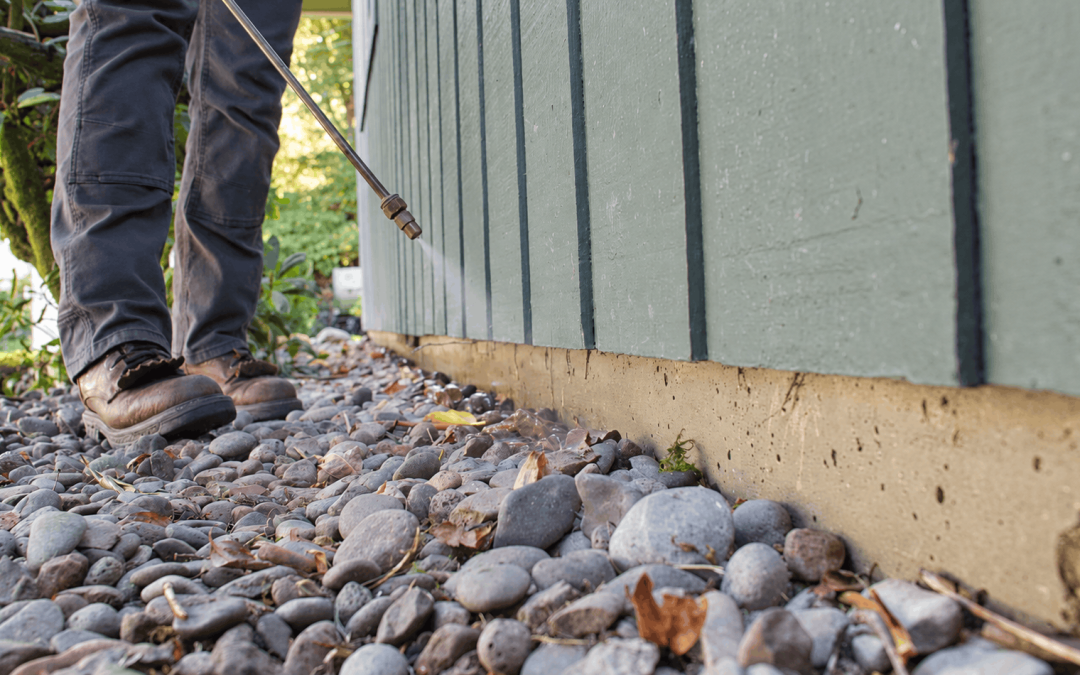
Repellent insecticides are commonly used in general pest management, particularly around the exterior of structures. At Good Earth, one of our primary products in this category is a pyrethroid insecticide.
Pyrethroids are synthetic insecticides modeled after naturally occurring compounds found in chrysanthemum flowers. They affect the nervous systems of insects and can provide residual control when applied to appropriate surfaces.
These products can be useful for managing spiders, occasional invaders, and certain other pests around the exterior of a home. They’re not appropriate for every situation, though. Some can be particularly hazardous to aquatic organisms and beneficial insects, which makes application location, weather conditions, and label restrictions especially important.
We don’t want pesticides drifting onto flowering plants, entering waterways, or ending up somewhere they don’t belong. The objective is to treat appropriate areas where pests are likely to encounter the product, not to coat the entire yard.
Non-Repellent Insecticides
Non-repellent insecticides are among my favorite tools for certain pest problems, particularly ants and cockroaches.
Unlike repellent products, which may cause insects to avoid treated areas, non-repellents are designed so that target pests don’t readily detect the treatment. Depending on the active ingredient, insects may contact or ingest the product and experience its effects later.
For some products and pests, this delayed action can allow the insecticide to affect additional individuals within a colony. That’s especially useful when we’re dealing with social insects like carpenter ants, where killing a handful of foraging workers doesn’t necessarily accomplish much.
We use products containing active ingredients such as fipronil and dinotefuran in appropriate situations. These materials have different properties, application restrictions, and environmental considerations, so choosing the right one requires more than simply deciding which bottle to grab.
For example, fipronil is highly toxic to bees and certain aquatic organisms. That doesn’t mean it can never be used appropriately, but it does mean exposure prevention and adherence to the product label are essential.
Insect Baits
Baits are another important part of our pest management toolbox. Rather than applying a pesticide broadly to surfaces, we can sometimes take advantage of the pest’s natural feeding behavior.
Ant baits, for example, contain an attractive food material combined with an insecticide. Foraging ants collect the bait and, depending on the species and product, may distribute it among other members of the colony.
Cockroach baits operate on a similar principle, although the biology and placement strategies are different.
The advantage is that we can often place relatively small amounts of pesticide in specific locations where the target pests are feeding or traveling. Baits aren’t universally effective, and their success depends on correct identification, placement, competing food sources, and other conditions, but they can be an excellent alternative to more extensive liquid applications.
There’s something satisfying about getting ants to participate in their own pest control program.
Rodenticides
Rodenticides deserve special attention because they’re designed to affect mammals, and that means we have to be particularly careful about unintended exposure.
We use several different rodent bait products, including anticoagulant and non-anticoagulant formulations. They work through different biological mechanisms, but they share an important characteristic: they’re intended to be toxic when consumed by the target rodents.
Unfortunately, rodents aren’t the only animals capable of consuming bait. Dogs, cats, wildlife, and other non-target animals can also be exposed, and some rodenticides can present risks to predators and scavengers that consume poisoned rodents.
That’s why bait placement, appropriate bait stations, monitoring, and the decision to use bait in the first place are so important.
At Good Earth, rodent management isn’t simply a matter of putting poison around a building. We also look for entry points, food sources, shelter, and other conditions contributing to the problem. Trapping, exclusion, and habitat modification can all play important roles.
A mouse can’t get into your kitchen through a hole that no longer exists. Well, at least not through that hole.
Insect Growth Regulators and Dusts
We also use more specialized products when the situation calls for them.
Insect growth regulators, or IGRs, interfere with aspects of insect development or reproduction. They’re useful in certain flea and cockroach management programs and are often combined with other methods to address multiple stages of an infestation.
Insecticidal dusts can be useful in cracks, crevices, wall voids, and other locations where appropriate placement provides access to pest harborages. Depending on the product, they may work through chemical toxicity or physical effects on the insect.
These aren’t products we simply scatter around a house. Placement matters, and so do the specific label directions and the potential for people or pets to contact the material.
What About Natural and Organic Pest Control Products?
This is another area where marketing has gotten a little ahead of the science.
There’s a common assumption that natural products are safer than synthetic ones. Sometimes a naturally derived product may offer advantages for a particular application, but its origin doesn’t automatically tell us how hazardous it is.
Nicotine is natural. So is arsenic. Neither is something I’d recommend adding to your morning smoothie.
Many plant-derived pesticides contain essential oils or other compounds that can irritate skin, affect animals, or cause other adverse effects at sufficient exposure levels. Some products marketed as natural are also less effective against particular pests, potentially leading to repeated applications without solving the underlying problem.
You may also encounter products described as FIFRA 25(b) minimum-risk pesticides. These products can qualify for an exemption from federal EPA pesticide registration when they meet specific requirements. That exemption isn’t the same thing as an EPA determination that every possible use is harmless.
We evaluate products based on their effectiveness, toxicity, exposure potential, application requirements, and suitability for the problem. Whether an ingredient originally came from a plant or a laboratory is only part of the picture.
Does Good Earth Use Pesticides Preventatively?
Yes, and this is an important part of how we approach pest management.
Some pests are predictable enough that waiting for a serious infestation before taking action doesn’t make much sense. Here in western Oregon, rats, mice, and odorous house ants can create problems throughout much of the year. Carpenter ants and yellowjackets have more pronounced seasonal patterns, but their activity is predictable enough that preventative measures can be valuable.
A preventative program allows us to inspect for developing problems, monitor activity, address conducive conditions, and make targeted applications when they’re warranted. Rather than waiting for rodents to establish themselves in an attic or ants to become a recurring problem in the kitchen, we can work to reduce the likelihood of those situations developing.
That doesn’t mean applying pesticides everywhere on every visit. Preventative service should still be based on pest biology, site conditions, previous activity, and the specific needs of the property.
Sometimes the most useful thing we do during a service is identify a condition that needs correcting. A leaking hose bib, vegetation against the siding, an improperly sealed crawlspace vent, or a gap beneath a garage door may be contributing more to the problem than anything we could accomplish with another pesticide application.
Which brings us to Integrated Pest Management.
Integrated Pest Management: Using More Than Pesticides
Integrated Pest Management, or IPM, is the foundation of how we approach pest problems at Good Earth.
The basic idea is that effective pest management requires understanding the pest and the environment supporting it. Pesticides are one tool, but they’re not the only tool, and sometimes they’re not even the most important one.
If ants are entering a kitchen because a colony has established itself beneath the foundation, we need to understand the species and its nesting behavior. If rodents are repeatedly appearing in a garage, we should be looking for entry points. If fruit flies are breeding in organic buildup inside a floor drain, spraying adult flies without addressing the breeding material isn’t likely to accomplish much.
Our goal is to identify the problem, understand what’s contributing to it, and select the combination of methods most likely to provide lasting results.
That may involve sanitation, exclusion, moisture management, habitat modification, monitoring, trapping, or targeted pesticide applications. Often it’s several of those things working together.
And sometimes, after inspecting the situation, the right recommendation is to leave the insect alone. Not every spider in the garden or bee visiting the flowers needs to become a pest control project.
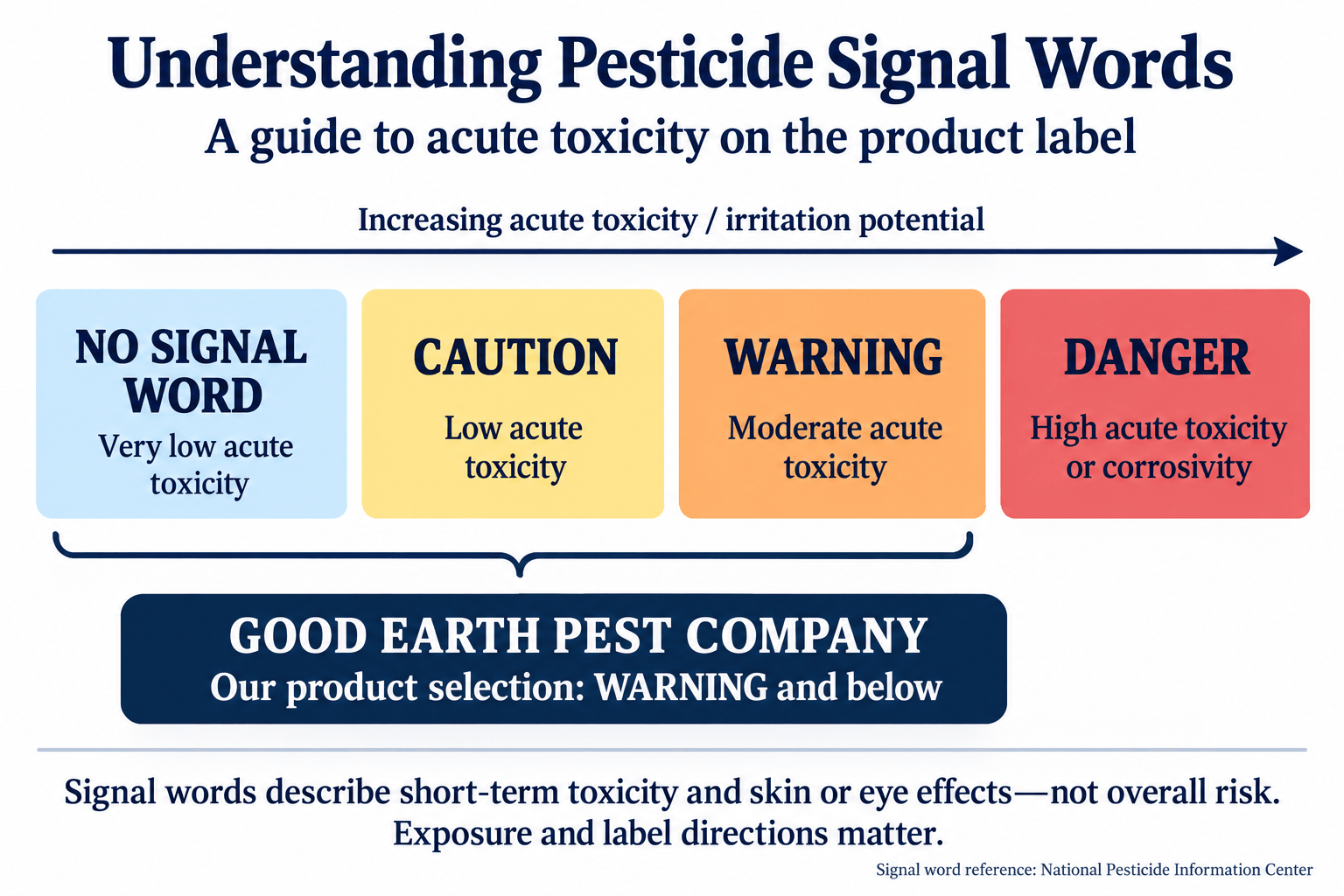
Good Earth uses products labeled WARNING, CAUTION, or with no required signal word. Signal words describe acute toxicity, not overall risk.
Are the Products Safe for Children and Pets?
This is probably the question we hear most often, and it’s one I take seriously.
Children and pets can encounter treated areas differently from adults. Young children spend more time close to floors and frequently put their hands or objects in their mouths. Pets may investigate bait stations, lick surfaces, or explore areas of the property that people rarely visit.
Those behaviors can create exposure pathways that need to be considered when planning a treatment.
When selecting and applying products, we consider where people and animals spend their time, how they might encounter the material, and what restrictions the label requires. That may mean placing baits in inaccessible locations, using appropriate tamper-resistant rodent bait stations, limiting applications to particular areas, or keeping people and pets away from treated surfaces until the label’s re-entry conditions have been met.
We also need to consider individual circumstances. A household with crawling infants, curious dogs, aquariums, backyard chickens, or honey bee hives may require additional planning.
The goal isn’t to convince you that pesticides are harmless. It’s to select and use them in ways that minimize unnecessary exposure while still accomplishing the treatment objective.
If you have specific concerns about a product, ask us. We can explain what we’re using, where it’s being applied, and what precautions are required.
What About Long-Term Exposure?
It’s reasonable to ask whether repeated pesticide treatments could create long-term health concerns. Pesticides vary considerably in their toxicological properties, and some substances can cause adverse effects following sufficient or repeated exposure.
This is also why it’s important not to confuse a product’s acute toxicity with its potential long-term effects. The signal words on pesticide labels primarily communicate certain immediate toxicity and irritation hazards; they don’t provide a complete picture of every possible chronic health or environmental concern.
When evaluating long-term risk, we need to consider the specific active ingredient, formulation, amount applied, application frequency, environmental persistence, and actual exposure. A pesticide placed inside an inaccessible wall void presents a different exposure scenario from one repeatedly applied to a surface that people frequently touch.
Reducing unnecessary exposure is one of the reasons we emphasize targeted treatments and IPM. We don’t need to pretend every pesticide is harmless to recognize that thoughtful product selection and application practices can substantially influence risk.

An unexpected ride-along checking out the view from our ladder rack.
Can Pesticides Harm the Environment?
Absolutely. Depending on the product, pesticides can affect beneficial insects, aquatic organisms, birds, mammals, and other non-target species.
This is particularly important around flowering plants, waterways, storm drains, and areas where wildlife may encounter treated surfaces or bait. Some insecticides that work extremely well against structural pests are also highly toxic to bees or aquatic invertebrates.
Rodenticides present their own concerns because non-target animals may consume bait directly, and certain products can also create secondary poisoning risks.
That’s why we pay attention to application sites, weather, label restrictions, bait placement, and opportunities to manage pests without chemical treatment.
The objective isn’t to eliminate every insect and animal around your property. Most of them aren’t causing any trouble, and many are doing useful work.
We want to manage the pests that are creating problems while limiting unintended effects on everything else.
So, Should You Be Worried About the Chemicals We Use?
I think you should be informed about them.
There’s a difference between being concerned and being afraid, and good pest control companies should be willing to explain that difference.
You should know what products are being used on your property, why they’re being selected, where they’re being applied, and what precautions you need to follow. You should also feel comfortable asking whether a particular treatment is necessary or whether another approach might work.
I don’t expect every customer to become an amateur toxicologist. That’s part of what you’re hiring us for. But I do think you deserve something more useful than being told, “Don’t worry, it’s completely safe.”
If you’d like to research a particular pesticide yourself, the National Pesticide Information Center at Oregon State University is an excellent resource for objective information about pesticide toxicity, exposure, and environmental effects.
Final Thoughts
Yes, Good Earth Pest Company uses chemicals. We use insecticides, rodenticides, baits, growth regulators, and other products when they’re appropriate for the problem we’re trying to solve.
Are they toxic? Many are, to varying degrees. That’s part of how they work, and pretending otherwise wouldn’t be particularly honest.
But toxicity alone doesn’t tell us the whole story. Understanding risk requires looking at the product, the amount used, how it’s applied, and the likelihood of exposure. That’s why we emphasize knowledgeable technicians, appropriate product selection, targeted applications, and Integrated Pest Management.
We’re not interested in using more pesticide than necessary, and we’re certainly not interested in treating every living thing around your home as an enemy.
If you have questions about what we’re using, please ask. We enjoy talking about this stuff, probably more than most people enjoy listening to it. Understanding the products we use and the reasons behind our decisions is an important part of what makes us pest management professionals.
At Good Earth, we’d rather have an informed customer asking difficult questions than one who’s afraid to ask them.
At Good Earth Pest Company, we believe informed decisions start with reliable information. If you’d like to learn more about pesticide toxicity, exposure, environmental effects, and how pesticides are regulated, we recommend the following resources:
- National Pesticide Information Center (NPIC) – Based at Oregon State University, NPIC provides science-based information about pesticide ingredients, human and animal exposure, toxicity, and environmental risks.
- S. Environmental Protection Agency (EPA) – Pesticides – Information about pesticide registration, safety evaluations, labeling requirements, and federal pesticide regulations.
- EPA – Integrated Pest Management (IPM) Principles – An overview of how prevention, monitoring, and targeted treatments can reduce unnecessary pesticide use.
- EPA – Protecting Pets from Pesticides – Guidance on reducing pesticide exposure risks for household pets.
These resources provide additional context for the topics discussed in this article. For questions about specific products used during a Good Earth service, we’re always happy to explain what we’re applying, why we’ve selected it, and what precautions are appropriate.